 |
 |
 |
 |
 |
 |
 |
 |
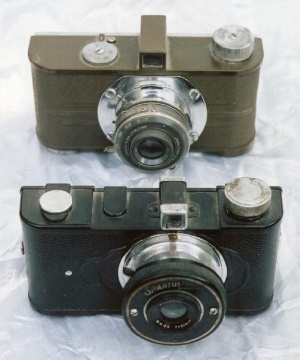
| Comparing the Spartus Miniature Half-frame 127 roll film camera to the 35mm Argus A. |
| I was given the Spartus Miniature by my mother when I was about 13 and I used it for several years. About 30 years later a fellow empoyee brought me the Argus A for evaluation and I purchased it. I immediately noticed the overall similarity with the Spartus Miniature. I'm not sure that it was a deliberate copy; it may have just been a matter of form fitting a common function. The Spartus uses 127 roll film, but it was formatted for half-frame exposures. So two 1 3/4 by 1 1/4 (45mm x 32mm) vertical images were placed on one normal 2 1/2 by 1 3/4 horizontal frame. The resulting images are just slightly larger than the standard 35mm image. The back was held in place with a fixed clip and a spring tensioned clip. A very good spring is fixed under the clip; it is not a simple springy clip such as many cheap cameras have. |
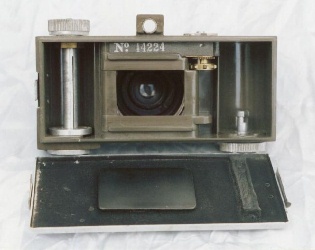
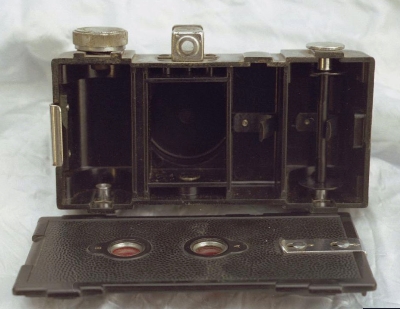
| The film cartridge is loaded onto the slotted take-up axle on the right. The only provided to stabilze the cartridge is the foam block on the camera back. There is only one sprocket and it is not used to advance the film; only to stop the film after one frame advance and advance the frame counter. The winding spool is a simple slotted aluminum cylinder. The film pressure plate is fastened to the camera back with foam to provide some flexibility. In this example, the foam has hardened. The clip on the right end of the back grips a raised place on the body and a slightly springy clip on the left of the camera body engages a clip on the back. |
| The Spartus Miniature did not have a film pressure plate. This was typical of roll-film cameras. An unexposed roll of film was placed in the compartment on the right. An empty spool is shown in the photo. A spring-metal clip is riveted to the body to maintain tension on the roll. The paper back is then threaded across to the take-up spool on the left. The take-up knob is racheted to prevent reverse motion. This helps maintain tension on the film to keep it flat across the back of the exposure chamber. A compartment just to the right of the exposure chamber is provided for storage of a spare roll of film. The sturdy metal tripod socket is visible just below the exposure chamber. |
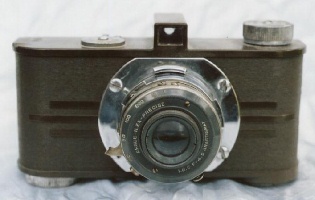
| The body is an olive drab Bakelite plastic. The lens and shutter and diaghram controls are mounted on a metal barrel. This can be pushed into the body and locked into place to make a more compact profile. It must be released to spring back out before use. The lens is a fixed-focus Argus Ilex Precise I.R.C. F-4.5 anastigmat. Diaphragm (lens opening) can be set from 4.5 to 11. Shutter speeds are 1/25, 1/50, 1/100, 1/200, Bulb, and Time. The shutter release is at the lower left. (Operators lower right) The is a connection for a cable shutter release. |
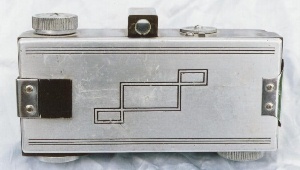
| Film advance knob is top left. Rewind knob is at lower right. The tripod socket is in the aluminum metal circle at lower left. The back cover is stamped aluminum. The clips are chrome plated. The black square is a leather flap that aids back removal. |
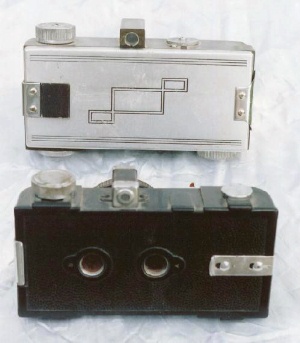
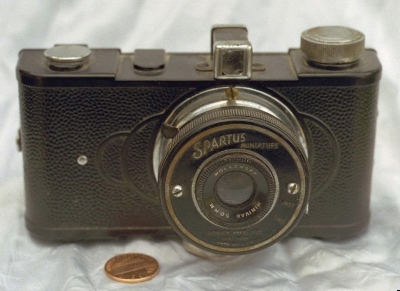
| The Spartus Miniature was made by the Utility Mfg. Co. of New York 'Made in U.S.A.' The body is made of sturdy, dimensionally stable Bakelite (TM) plastic with metal fittings. The lens and shutter mechanism is extended from the body on a metal barrel. The camera is equipped with a Wollensak Minivar 50mm single element uncoated, uncorrected, fixed-focus lens. The name and other information is on a metal washer fastened to the lens housing. The shutter speeds are INST. and TIME selected by the small lever at the lower right of the lens. Shutter release is at upper left.The 'instantaneous' speed was probably about 1/50 sec. The lens opening was probably f/11. The fixed focus distance was roughly 5 feet to infinity. The camera has a brass tripod socket. The view-finder was centered over the lens so that lateral parallex was not a problem. |
| If this article was interesting or helpful to you, please sign the GUESTBOOK. Thanks! |
| Date Prepared 9/6/02 |

|
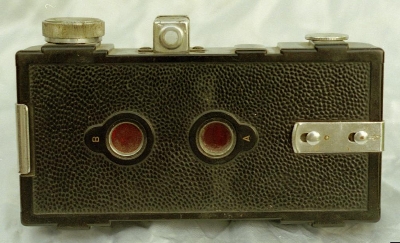
| Most roll-film cameras have only one frame positioning window, but since this is a half-frame camera, it has 'A' and 'B' windows. The frame number is first postioned at 'A' and, after an exposure is made, it is moved to 'B' and a second exposure is made on the other half of the frame. |